Difference Between Invoice, Receipt and Bill: Legal Meanings, GST Rules & Formats (2026)
Understand the legal differences between an Invoice, Receipt, and Bill under GST. Learn Section 31 Tax Invoices, Rule 49 Bills of Supply, and Section 269ST ₹2 Lakh cash receipt penalties.
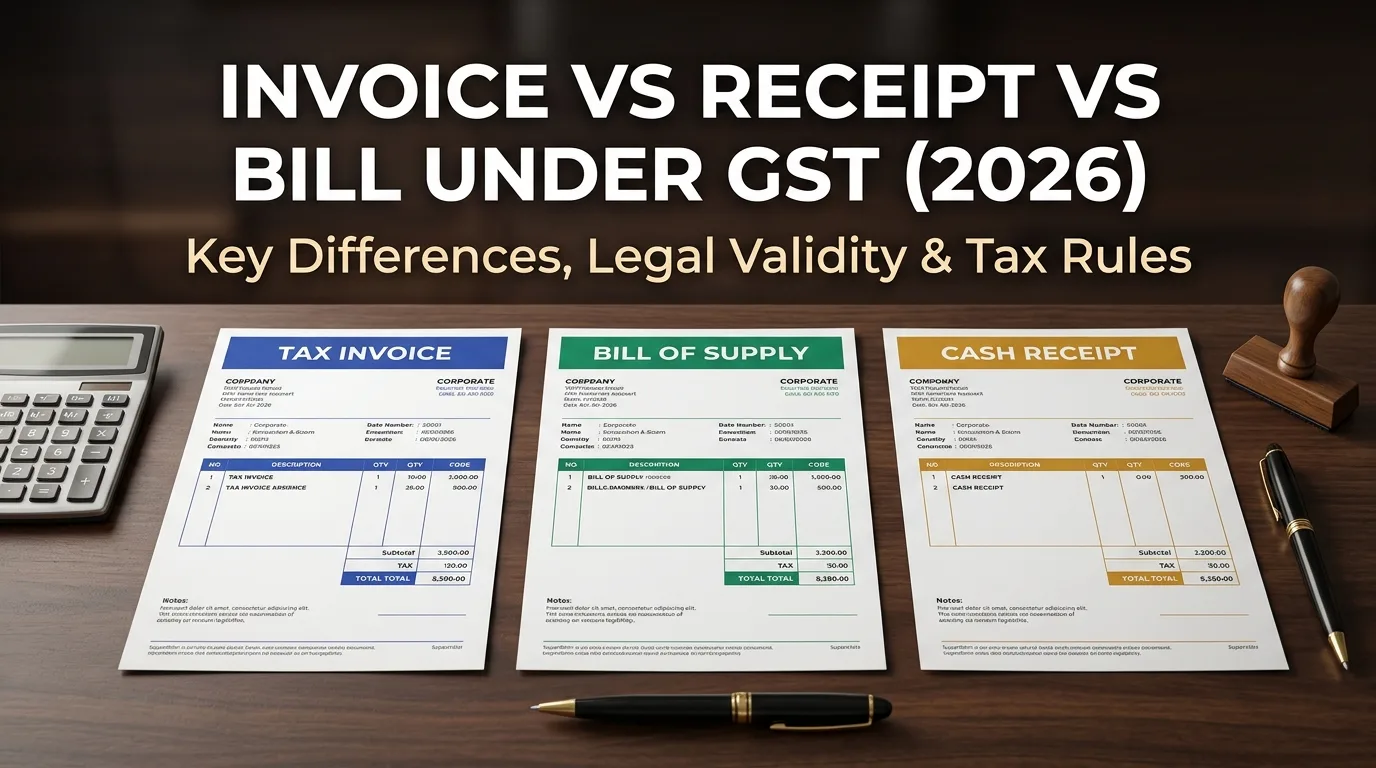
Exhaustive legal comparison of Invoice vs Receipt vs Bill: Section 31 rules, Bill of Supply, ITC eligibility, Section 269ST cash limits, and format templates.
In everyday commercial conversations across Indian markets—from Kirana counters and wholesale textile mandis to corporate finance departments—the terms "Invoice", "Receipt", and "Bill" are frequently used as interchangeable synonyms. A customer asks for a "bill" at a restaurant; an accounts executive requests an "invoice" for software subscription; and a shopkeeper hands over a "cash receipt" upon receiving payment.
However, under Indian tax jurisprudence—specifically the Central Goods and Services Tax (CGST) Act, 2017, the Income Tax Act, 1961, and the Indian Contract Act, 1872—these three documents carry vastly different legal definitions, statutory timings, and financial consequences.
Confusing an invoice with a receipt, or issuing a standard bill when a statutory Tax Invoice is legally required, can result in severe repercussions: loss of Input Tax Credit (ITC) for your corporate buyers, automated scrutiny notices under Section 61, or catastrophic 100% penalties under Section 271DA of the Income Tax Act for cash transactions violating Section 269ST.
This definitive 2026 legal and accounting guide breaks down the difference between invoice receipt and bill, side-by-side comparison tables, statutory rules under CGST Section 31 and Rule 49, cash transaction limits, and standard commercial format layouts.
What is the Difference Between an Invoice, Receipt, and Bill? (BLUF Box)
Bottom Line Up Front (BLUF):
Under Indian law:
- An Invoice (Tax Invoice under Section 31) is a formal legal demand for payment issued by a seller before or at the time of delivery, itemizing goods/services, HSN codes, and applicable GST. It enables registered buyers to claim Input Tax Credit (ITC).
- A Bill (or Bill of Supply under Rule 49) is issued for immediate non-credit retail purchases, exempt goods, or by composition dealers where no GST can be charged, offering zero ITC.
- A Receipt (Section 31(3)(e) / Payment Voucher) is issued after payment is received, functioning as conclusive legal proof of debt settlement and cash/bank transfer.
flowchart TD
    A["Commercial Transaction Initiated"] --> B{"Is Payment Made Concurrently with Delivery?"}
    B -- "NO (Credit Sale / Commercial B2B)" --> C["Issue TAX INVOICE (Sec 31)<br>• Formal Demand for Payment<br>• Itemized HSN & GST Rates<br>• Buyer Avails ITC"]
    C --> D["Customer Processes Payment (UPI/NEFT/Cheque)"]
    D --> E["Issue PAYMENT RECEIPT / VOUCHER<br>• Conclusive Proof of Settlement<br>• Closes Accounts Receivable"]
    B -- "YES (Retail Cash / Composition / Exempt)" --> F{"Taxable or Exempt / Composition?"}
    F -- "Composition Dealer or Exempt Goods" --> G["Issue BILL OF SUPPLY (Rule 49)<br>• Cannot Charge GST<br>• Zero ITC for Buyer"]
    F -- "Immediate B2C Retail Counter" --> H["Issue RETAIL BILL / CASH INVOICE<br>• Functions as Simultaneous Demand & Payment Proof"]
1. What is an Invoice? (The Legal Demand for Payment)
An Invoice (specifically a Tax Invoice under GST) is a commercial instrument issued by a registered supplier of goods or services to a buyer. It itemizes the products or services delivered, agreed prices, applicable taxes (CGST, SGST, IGST), transportation terms, and payment due dates.
Statutory Foundations under GST:
- Governing Section: Section 31 of the CGST Act, 2017 read with Rule 46 of the CGST Rules.
- Timing of Issuance (Goods): Must be issued on or before the date of removal of goods for supply to the recipient, or on delivery where supply does not involve movement.
- Timing of Issuance (Services): Must be issued before or within 30 days from the date of the provision of service (45 days for banking and financial institutions).
- Core Legal Function: It establishes an Accounts Receivable in the seller's ledger and an Accounts Payable in the buyer's ledger. It is the primary legal document required for a buyer to claim Input Tax Credit (ITC) under Section 16(2)(a).
To generate compliant GST tax invoices with automatic HSN and CGST/SGST/IGST calculations, use SuperBiller's Free Online Invoice Generator.
2. What is a Bill? (The Point-of-Sale Total & Bill of Supply)
In common parlance, a "Bill" refers to a statement of charges presented to a customer for immediate settlement (such as a grocery bill, restaurant dining bill, or electricity bill). Under GST law, the term takes on a precise statutory meaning: a Bill of Supply.
Statutory Foundations under GST:
- Governing Section: Section 31(3)(c) of the CGST Act read with Rule 49 of the CGST Rules.
- Who Issues a Bill of Supply?
- Composition Taxpayers: Small businesses registered under Section 10 paying 1%, 5%, or 6% flat turnover tax.
- Suppliers of 100% Exempt Goods / Services: Merchants dealing exclusively in nil-rated or exempt items (such as fresh fruits, unbranded pulses, milk, or curd).
- The Absolute Legal Prohibition: A Bill of Supply CANNOT charge any GST to the customer. It contains no tax rate columns, and the buyer cannot claim any Input Tax Credit (ITC) based on a Bill of Supply!
- Mandatory Header: Composition taxpayers must print the words "Composition taxable person, not eligible to collect tax on supplies" at the top.
To learn more about composition invoicing and tax slabs, read our comprehensive guide: GST Composition Scheme Rules (2026): Turnover Limit & Rates.
3. What is a Receipt? (Conclusive Proof of Payment)
A Receipt (or Payment Receipt / Receipt Voucher) is an acknowledgment issued by the payee (seller or service provider) confirming that money has been physically or digitally received from the payer.
Statutory Foundations:
- Governing Provisions: Section 31(3)(d) & (e) of the CGST Act (Receipt Voucher & Payment Voucher), Section 72 of the Indian Contract Act, 1872, and Section 269ST of the Income Tax Act, 1961.
- Timing of Issuance: Generated ONLY AFTER payment is received (whether as advance payment, partial milestone payment, or final invoice settlement).
- Core Legal Function: While an invoice says "You owe me ₹50,000", a receipt says "I have received ₹50,000 from you. The debt is discharged." In commercial litigation, a receipt acts as conclusive prima facie evidence in court that the payer has fulfilled their financial obligation.
- No Tax Breakdown: A standard commercial receipt records the payment method (Cash, UPI Reference, Cheque No., NEFT UTR), the invoice number being cleared, and the received amount. It does not carry fresh GST liability.
To generate professional cash, rent, and payment vouchers with instant WhatsApp dispatch, use SuperBiller's Free Receipt Generator.
Comprehensive 12-Parameter Comparison Matrix
| Comparative Parameter | Tax Invoice | Bill / Bill of Supply | Payment Receipt |
|---|---|---|---|
| Statutory Provision | Section 31 & Rule 46 of CGST Act | Section 31(3)(c) & Rule 49 | Section 31(3)(d)/(e) & Contract Act |
| Primary Commercial Purpose | Formal demand for payment & tax declaration | Statement of charges for retail / exempt sales | Legal acknowledgment of money received |
| Timing of Issuance | Before or at delivery (Goods) / 30 days (Services) | At the time of checkout / sale | After payment has been physically/digitally received |
| Tax Charged? | YES (Itemized CGST, SGST, IGST columns) | NO (Zero tax can be charged to buyer) | NO (Only records total funds received) |
| Input Tax Credit (ITC)? | Eligible (Primary instrument to claim ITC) | Zero ITC (Buyer cannot claim credit) | Zero ITC (Does not grant tax credit) |
| Mandatory HSN / SAC Code? | Mandatory based on turnover (4 or 6 digits) | Optional / Recommended for stock tracking | Not Applicable |
| E-Way Bill Linkage? | Directly linked to Part-A of E-Way Bill | Directly linked to Part-A for exempt transit | Not Applicable |
| Reporting on GST Portal | Mandatory in Form GSTR-1 (Table 4A, 4B, 5, 7) | Mandatory in GSTR-1 Table 8 (Exempt/Nil) | Only advance vouchers in Table 11 |
| Accounting Ledger Impact | Debits Accounts Receivable; Credits Sales & Tax | Debits Cash/Debtor; Credits Sales Revenue | Debits Bank/Cash; Credits Accounts Receivable |
| Income Tax Cash Limits | Must comply with cash collection limits | Must comply with cash collection limits | Strictly governed by Section 269ST |
| Typical Issuer | GST-registered regular businesses | Composition dealers, retail shops, exempt sellers | Any business, landlord, NGO, or professional |
| Recipient Possession | Retained by buyer for accounting & audit | Retained by retail consumer as purchase slip | Retained by payer as proof against false recovery |
The ₹2 Lakh Cash Transaction Rule: Section 269ST Penalties
When generating cash receipts or retail cash bills, Indian business owners must strictly adhere to the anti-black-money provisions of the Income Tax Act, 1961:
flowchart LR
    A["Cash Receipt Limit: Section 269ST"] --> B{"Does Cash Received Exceed ₹2,00,000?"}
    B -- YES --> C["Severe Violation!<br>Section 271DA Penalty: 100% of Cash Amount!"]
    B -- NO --> D["Legally Permissible<br>(Valid Cash Receipt)"]
    C --> E["Applies to: Single Day / Single Transaction / Single Event"]
Section 269ST Restrictions:
Under Section 269ST, no person shall receive an amount of ₹2,00,000 (Two Lakh Rupees) or more:
- In aggregate from a person in a day; OR
- In respect of a single transaction; OR
- In respect of transactions relating to one event or occasion from a person,
otherwise than by an account payee cheque, account payee bank draft, or electronic clearing system (NEFT/RTGS/UPI).
The 100% Penalty under Section 271DA:
If a merchant accepts ₹2,50,000 in physical cash from a customer against an invoice and issues a cash receipt, the Assessing Officer will levy a penalty under Section 271DA equal to 100% of the cash received (₹2,50,000 penalty!). The penalty falls entirely on the recipient (seller) who accepted the cash!
To verify daily cash drawer limits and audit counter cash collections, use SuperBiller's Cash Counter Calculator.
Anatomy & Formats of the Three Documents
Understanding the visual layout of each document prevents costly formatting errors:
1. Standard Tax Invoice Format (Excerpt):
====================================================================================================
                                      TAX INVOICE [ B2B SUPPLY ]
Invoice No.  : INV/2026/0891                                          Date: 26-Nov-2026
Supplier     : M/s Bharat Industrial Tools, Mumbai                   GSTIN: 27AAAAA0000A1Z5
Recipient    : M/s Apex Engineering Works, Pune                      GSTIN: 27BBBBB1111B1Z2
----------------------------------------------------------------------------------------------------
Item Description      | HSN   | Qty | Rate (₹) | Taxable Value (₹) | CGST (9%) | SGST (9%) | Total (₹)
----------------------+-------+-----+----------+-------------------+-----------+-----------+----------
Heavy Duty CNC Drill  | 8459  |  2  | 25,000.00|     50,000.00     |  4,500.00 |  4,500.00 | 59,000.00
----------------------------------------------------------------------------------------------------
Total Invoice Value (in Words): Fifty-Nine Thousand Rupees Only
Payment Due Date: 15-Dec-2026 | Bank A/c: HDFC Bank - 50200012345678 (IFSC: HDFC0000123)
====================================================================================================
2. Standard Bill of Supply Format (Excerpt):
====================================================================================================
                                         BILL OF SUPPLY
                   "Composition taxable person, not eligible to collect tax on supplies"
Bill No.     : BOS/2026/0412                                          Date: 26-Nov-2026
Supplier     : M/s Shreenath Grocery & Spices, Jaipur                 GSTIN: 08CCCCC2222C1Z8
Customer     : Mr. Rajesh Sharma (Retail Walk-in)                     Contact: +91 98765 43210
----------------------------------------------------------------------------------------------------
Item Description               | HSN   | Qty  | Unit Rate (₹) | Discount (₹) | Net Payable Amount (₹)
-------------------------------+-------+------+---------------+--------------+----------------------
Organic Turmeric Powder (500g) | 0910  | 4 pk |    140.00     |    20.00     |        540.00
Pure Desi Cow Ghee (1 Litre)   | 0405  | 2 tin|    650.00     |    50.00     |      1,250.00
----------------------------------------------------------------------------------------------------
Total Bill Amount: ₹ 1,790.00 (Zero GST Charged | No Input Tax Credit Available)
====================================================================================================
3. Standard Payment Receipt Format (Excerpt):
====================================================================================================
                                      OFFICIAL PAYMENT RECEIPT
Receipt No.  : RCP/2026/0078                                          Date: 26-Nov-2026
Received From: M/s Apex Engineering Works, Pune
Payment Mode : Bank NEFT Transfer (UTR Ref: HDFCN26330918231)
Against Ref. : Tax Invoice No. INV/2026/0891 dated 26-Nov-2026
----------------------------------------------------------------------------------------------------
Amount Received in Figures : ₹ 59,000.00
Amount Received in Words   : Fifty-Nine Thousand Rupees Only
Outstanding Balance on Inv : ₹ 0.00 (Invoice Fully Settled)
----------------------------------------------------------------------------------------------------
Received By: Bharat Industrial Tools (Authorized Cashier Signature & Stamp)
====================================================================================================
To print clean thermal receipts or download PDF invoices for customer records, explore SuperBiller's Retail POS System and Free Delivery Challan Generator.
Related In-Depth Guides & Recommended Reading
- Credit Note Rules & Formats: GST Credit Note Format & Time Limit (2026): Section 34 Rules & 30th Nov Deadline — How to adjust invoice values after issuance.
- Debit Note vs Credit Note Differences: Difference Between Debit Note and Credit Note Under GST — Double-entry accounting entries for commercial revisions.
- Composition Scheme Rules: GST Composition Scheme Rules (2026): Turnover Limit & Rates — Bill of supply rules for small traders.
- Form CMP-08 Quarterly Filing: Form CMP-08 Filing Guide: Due Dates & Late Fees — Quarterly statements for composition dealers.
- GTA Transport Services & Freight: GST on GTA Transport Services (2026): 5% RCM vs 12% Forward Charge — Consignment note and freight invoice requirements.
Frequently Asked Questions (FAQs)
Q1. Can an invoice serve as a receipt if it is stamped "PAID"?
In standard commercial practice, when an invoice is fully settled in cash or via card at the time of purchase and stamped "PAID" with the date, cashier signature, and payment reference, it functions as a Composite Cash Invoice cum Receipt. However, for credit sales where payment occurs weeks later, a separate formal Payment Receipt must be issued to record debt discharge.
Q2. Can a customer claim Input Tax Credit (ITC) using a Payment Receipt?
No! Under Section 16(2)(a) of the CGST Act, a registered person can claim ITC only if they are in possession of a valid Tax Invoice, Debit Note, or other prescribed tax-paying document. A Payment Receipt is merely proof of financial settlement and cannot be used to avail ITC.
Q3. Why can't a composition dealer issue a Tax Invoice?
Under Section 10(4) of the CGST Act, a composition taxpayer is legally barred from collecting any GST from their customers. Because they cannot charge tax, they are prohibited from issuing a Tax Invoice and must issue a Bill of Supply under Section 31(3)(c). Issuing a tax invoice as a composition dealer is a penal offense under Section 122(1)(iii).
Q4. What is the legal penalty for accepting cash of ₹2,00,000 or more?
Under Section 271DA of the Income Tax Act, 1961, if any person receives cash of ₹2,00,000 or more in violation of Section 269ST, the Joint Commissioner can levy a penalty equal to 100% of the cash amount received.
Q5. What is the difference between a Proforma Invoice and a Tax Invoice?
A Proforma Invoice is an informal quote or estimated quotation sent to a customer before the sale occurs to agree on pricing and terms. It carries zero accounting or tax validity. A Tax Invoice is an official commercial demand issued upon actual dispatch of goods, creating a binding tax liability and ITC entitlement.
Q6. Is a revenue stamp mandatory on cash receipts in India?
Under the Indian Stamp Act, 1899, any cash payment receipt issued for an amount exceeding ₹5,000 must bear a ₹1 Revenue Stamp, defaced by the signature or initials of the recipient. An unstamped receipt for cash over ₹5,000 is inadmissible as primary evidence in a court of law.
Statutory References & Official Government Sources
For authoritative tax acts, statutory rules, and government circulars:
- Central Board of Indirect Taxes and Customs (CBIC): Section 31 and Rules 46, 49, 52 of the CGST Rules, 2017 (cbic.gov.in).
- Income Tax Department of India: Section 269ST restrictions and Section 271DA penalties on cash receipts (incometax.gov.in).
- Ministry of Law and Justice: Indian Contract Act, 1872 & Indian Stamp Act, 1899 (indiacode.nic.in).
- GST Council Secretariat: Official guidelines on invoice formats and Rule 46 requirements (gstcouncil.gov.in).
This guide is authored by the SuperBiller Tax & Retail Operations Desk and fact-checked against official Central Board of Indirect Taxes and Customs (CBIC) circulars, the CGST Act 2017 (Rule 46 & Section 31), and latest GST Council threshold updates. SuperBiller provides MSMEs with compliant billing technology, 80mm thermal printing, and automated tax workflows.
Ready to automate your GST Billing & 80mm POS?
Generate your first tax invoice in under 30 seconds. 100% offline-ready.


