Difference Between Debit Note and Credit Note Under GST: Accounting Entries, Rules & Formats (2026)
Understand the key differences between debit notes and credit notes under GST. Compare Section 34 rules, tax liability impact, time limits, double-entry journal entries, and GSTR-1 reporting.
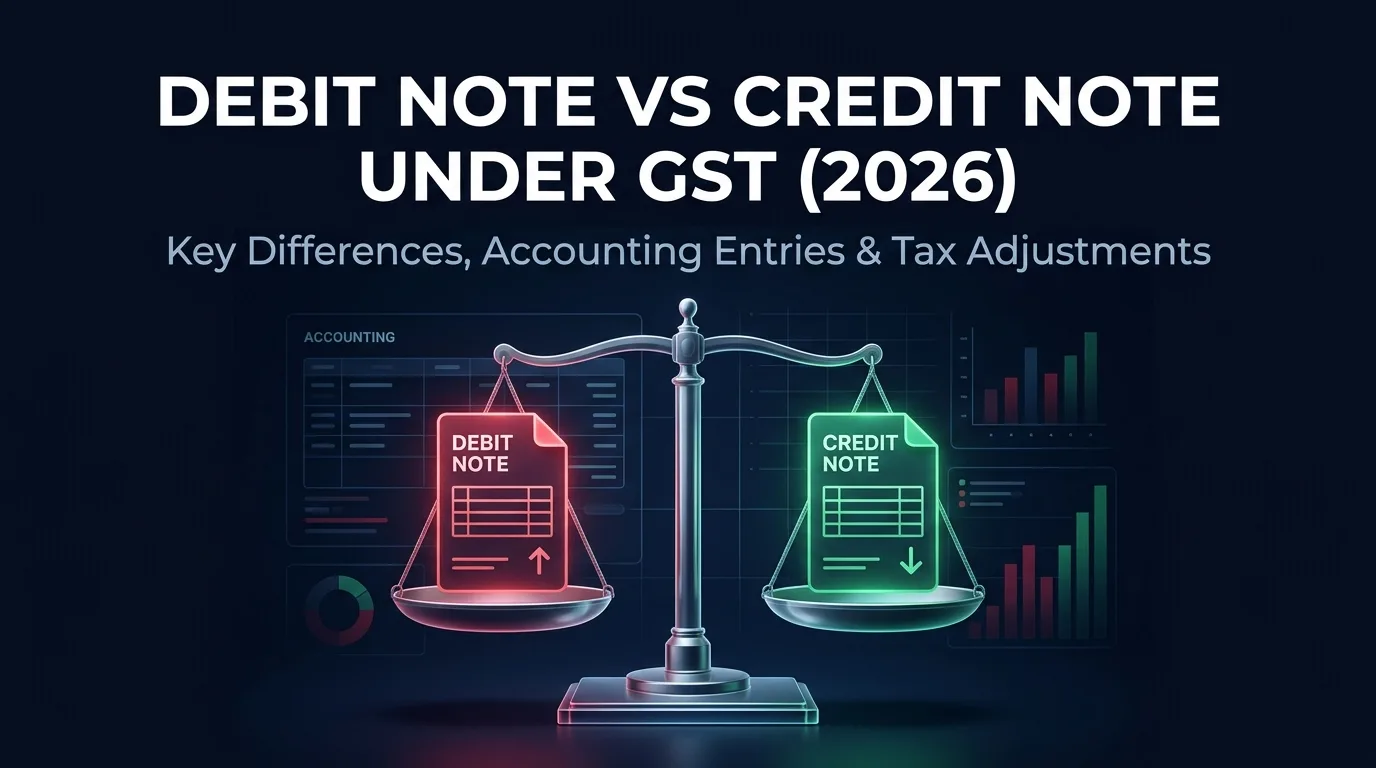
Exhaustive comparison of debit notes vs credit notes under GST: Section 34 rules, tax liability impact, no time limit for debit notes, and accounting entries.
In commercial bookkeeping and everyday Indian trading, business transactions are fluid. Prices get renegotiated after delivery; supplementary freight charges are tacked on; customers return defective cartons; or an invoice is typed with an incorrect tax slab. When the financial value of an issued invoice requires modification, businesses rely on two foundational commercial instruments: the Debit Note and the Credit Note.
Under the Goods and Services Tax (GST) regime, these are not just internal accounting entries. Governed by Section 34 of the Central Goods and Services Tax (CGST) Act, 2017, debit notes and credit notes carry profound tax consequences: one increases government tax liability and creates fresh Input Tax Credit (ITC), while the other reduces tax liability and mandates an ITC reversal.
Furthermore, there is a massive asymmetry in their statutory time limits: while credit notes are locked behind a strict 30th November cut-off, debit notes have NO upper time limit for issuance!
This definitive 2026 operational guide breaks down the difference between debit note and credit note under gst, side-by-side comparison tables, real-world double-entry journal entries, reporting rules in Form GSTR-1 Table 9B, and common audit pitfalls.
Debit Note vs Credit Note: The BLUF Summary Box
Bottom Line Up Front (BLUF):
Under GST law:
- A Credit Note (Section 34(1)) is issued by a supplier to reduce the taxable value or tax liability of an earlier invoice (due to sales returns, agreed post-sale discounts, or billing overcharges). It decreases the supplier's outward tax and requires the buyer to reverse ITC. It must be declared on or before 30th November following the end of the financial year.
- A Debit Note (Section 34(3)) is issued by a supplier to increase the taxable value or tax liability of an earlier invoice (due to undercharging price or tax rates, or supplementary supplies). It increases the supplier's outward tax and allows the buyer to claim additional ITC. There is NO upper time limit to issue a debit note!
flowchart TD
    A["Original Tax Invoice"] --> B{"Post-Sale Adjustment Required"}
    B -- "Price / Tax Charged Was Too HIGH<br>(Or Goods Returned)" --> C["Credit Note (Section 34(1))"]
    C --> D["Reduces Supplier Output GST"]
    C --> E["Buyer Reverses ITC in GSTR-3B"]
    C --> F["Strict Deadline: 30th November"]
    B -- "Price / Tax Charged Was Too LOW<br>(Or Extra Goods Sent)" --> G["Debit Note (Section 34(3))"]
    G --> H["Increases Supplier Output GST"]
    G --> I["Buyer Claims Fresh ITC in GSTR-3B"]
    G --> J["NO Upper Time Limit for Issuance"]
Comprehensive Comparison: Debit Note vs Credit Note Under GST
To understand the legal, operational, and financial contrasts between both instruments, study this exhaustive 10-point comparison table:
| Comparative Parameter | Statutory GST Credit Note | Statutory GST Debit Note |
|---|---|---|
| Statutory Section | Section 34(1) of the CGST Act, 2017 | Section 34(3) of the CGST Act, 2017 |
| Governing CGST Rule | Rule 53(1A) of the CGST Rules, 2017 | Rule 53(1A) of the CGST Rules, 2017 |
| Trigger Conditions | 1. Taxable value in invoice exceeds actual value<br>2. Tax charged exceeds actual tax<br>3. Goods returned by recipient (sales return)<br>4. Deficiency in goods or services | 1. Taxable value in invoice is less than actual value<br>2. Tax charged is less than actual tax<br>3. Upward price revision or supplementary charges |
| Impact on Supplier's Tax | Reduces outward tax liability (Tax outflow decreases) | Increases outward tax liability (Must pay extra tax to government) |
| Impact on Recipient's ITC | Recipient must reverse ITC in Table 4(B) of GSTR-3B | Recipient can claim additional ITC in Table 4(A)(5) of GSTR-3B |
| Statutory Deadline to Issue | Strictly 30th November following the end of the FY (or GSTR-9 date) | NO statutory time limit! (Can be issued even after 2 years) |
| Time Limit for Buyer's ITC | Buyer must reverse whenever issued (Interest under Sec 50 if delayed) | Buyer must claim on or before 30th November following FY of Debit Note date (Sec 16(4)) |
| E-Way Bill Requirement | Mandatory if returned goods value exceeds ₹50,000 | Mandatory if additional goods transported exceed ₹50,000 |
| GSTR-1 Reporting Table | Table 9B (Credit Notes - Registered / Unregistered) | Table 9B (Debit Notes - Registered / Unregistered) |
| Financial Connotation | Supplier owes money to buyer (Customer's account is credited) | Buyer owes more money to supplier (Customer's account is debited) |
Why Is There No Time Limit for Debit Notes? (The Revenue Logic)
Many merchants ask: Why does the GST law strictly cap Credit Notes at 30th November, but allows Debit Notes to be issued at any time?
The statutory logic comes down to government tax revenue:
- Credit Notes REDUCE Tax Revenue: When a supplier issues a credit note, the government treasury loses tax revenue because the supplier pays less tax. To prevent taxpayers from endlessly opening past financial years to manufacture artificial tax deductions, the law created a hard cut-off on 30th November.
- Debit Notes INCREASE Tax Revenue: When a supplier issues a debit note under Section 34(3), the supplier is voluntarily paying MORE tax into the government treasury (plus applicable interest). Because the government always welcomes additional tax revenue, Section 34(3) imposes no time restriction whatsoever on issuing debit notes.
[!NOTE]
Important Reform in Section 16(4) for Debit Notes:
Prior to the Finance Act 2020, the deadline to claim ITC on a debit note was tied to the date of the original underlying invoice. This was amended by inserting a delinking provision: today, under amended Section 16(4), the recipient can claim ITC on a debit note up to 30th November following the financial year in which the DEBIT NOTE was issued, regardless of when the original invoice was dated!
To compute accurate interest charges or test invoice differential amounts, use SuperBiller's Free GST Late Fee Calculator and Free GST Calculator Online.
Double-Entry Accounting Journal Entries (Real-World Examples)
To ensure your books of accounts balance perfectly with your GST portal filings, let us look at the exact accounting entries in both the Supplier's and Buyer's general ledgers.
Scenario A: Issuing a Credit Note (Sales Return)
- Transaction: Customer returns 20 units of electronic gadgets billed at ₹10,000 + 18% IGST (₹1,800) = Total ₹11,800.
1. In the Supplier's Books (Seller):
| Date | General Ledger Account | Debit (₹) | Credit (₹) |
|---|---|---|---|
| 26-Nov-2026 | Sales Return Account (Dr.) | 10,000.00 | |
| Output IGST Ledger (Dr.) | 1,800.00 | ||
| To Customer / Debtor A/c (Cr.) | 11,800.00 | ||
| (Being Credit Note No. CN/042 issued for sales return of defective gadgets) |
2. In the Buyer's Books (Customer):
| Date | General Ledger Account | Debit (₹) | Credit (₹) |
|---|---|---|---|
| 26-Nov-2026 | Vendor / Creditor A/c (Dr.) | 11,800.00 | |
| To Purchase Return Account (Cr.) | 10,000.00 | ||
| To Input Tax Credit (IGST) Reversal A/c (Cr.) | 1,800.00 | ||
| (Being credit note received from vendor and ITC reversed in books) |
Scenario B: Issuing a Debit Note (Under-Billed Price Revision)
- Transaction: Raw material was billed at ₹50,000 + 18% GST instead of the agreed contract price of ₹60,000. The supplier issues a supplementary Debit Note for ₹10,000 + 18% GST (₹1,800) = Total ₹11,800.
1. In the Supplier's Books (Seller):
| Date | General Ledger Account | Debit (₹) | Credit (₹) |
|---|---|---|---|
| 26-Nov-2026 | Customer / Debtor A/c (Dr.) | 11,800.00 | |
| To Sales Revenue Account (Cr.) | 10,000.00 | ||
| To Output IGST Payable A/c (Cr.) | 1,800.00 | ||
| (Being Debit Note No. DN/089 issued for upward price revision under Sec 34(3)) |
2. In the Buyer's Books (Customer):
| Date | General Ledger Account | Debit (₹) | Credit (₹) |
|---|---|---|---|
| 26-Nov-2026 | Purchase Expense A/c (Dr.) | 10,000.00 | |
| Input Tax Credit (IGST) A/c (Dr.) | 1,800.00 | ||
| To Vendor / Creditor A/c (Cr.) | 11,800.00 | ||
| (Being debit note received from supplier and additional ITC availed) |
To automate inventory valuation and invoice price adjustments seamlessly, shopkeepers rely on SuperBiller's Free Online Invoice Generator and Cloud Inventory Software.
Debit Notes Issued by Buyers vs Suppliers (The Common Confusion)
In traditional commercial accounting, when a buyer returns goods to a vendor, the buyer's accountant issues an internal document called a "Purchase Return Debit Note" (debited to the seller's account).
What Does GST Law Say?
Under the GST Act, only the SUPPLIER can issue a statutory GST Debit Note or Credit Note that adjusts tax on the GST Common Portal:
- Buyer's Debit Note is strictly an INTERNAL commercial voucher: A buyer cannot upload a debit note to the GST portal to adjust taxes. The GST portal does NOT accept debit notes from recipients!
- The Tax Chain Must Originate from the Supplier: For the supplier's outward tax liability to adjust and for GSTR-2B to auto-populate, the supplier must issue a Credit Note under Section 34(1).
- Summary Rule:
- Supplier issues Credit Note ➡️ Reduces Tax ➡️ Buyer reverses ITC.
- Supplier issues Debit Note ➡️ Increases Tax ➡️ Buyer claims additional ITC.
flowchart LR
    subgraph Buyer's Action
        A["Buyer Discovers Defect"] --> B["Issues Internal Commercial Debit Note"]
    end
    subgraph Supplier's Statutory Action
        B --> C["Supplier Receives Notice"]
        C --> D["Supplier Issues Official GST Credit Note (Sec 34(1))"]
        D --> E["Uploaded to GSTR-1 Table 9B"]
    end
    E --> F["Portal Automatically Adjusts Both Parties' Tax Ledgers!"]
Mandatory Fields on GST Debit and Credit Notes (Rule 53)
Under Rule 53(1A) of the CGST Rules, 2017, both debit and credit notes must contain standard statutory fields:
- Heading: Prominently titled "DEBIT NOTE" or "CREDIT NOTE".
- Supplier Details: Legal name, trade name, address, and 15-digit GSTIN.
- Serial Number: Consecutive serial number not exceeding 16 alphanumeric characters, unique for that financial year.
- Date of Issue: Date on which the note is generated.
- Recipient Details: Name, delivery address, and GSTIN / UIN (if registered).
- Original Tax Invoice Reference: Number and date of the original tax invoice against which the adjustment is made.
- Value & Tax Breakdown: Taxable value, tax rate, and distinct CGST, SGST, IGST, and Cess columns.
- Digital Signature: Digital signature certificate (DSC) or authorized physical signature.
Related In-Depth Guides & Recommended Reading
- Credit Note Time Limit & Formats: GST Credit Note Format & Time Limit (2026): Section 34 Rules & 30th November Deadline — Detailed guide to sales returns, Table 9B reporting, and financial credit notes.
- GST Scrutiny Notice Defense: GST Notice Reply Formats in Word & PDF (ASMT-10 & DRC-01) — Reconciling Table 9B mismatches against GSTR-3B.
- GSTR-2B vs Books Reconciliation: GSTR-2B vs Books Reconciliation & Rule 37 ITC Reversals — Matching vendor debit/credit notes in monthly returns.
- GTA Transport & Logistics Rules: GST on GTA Transport Services (2026): 5% RCM vs 12% Forward Charge — Credit and debit adjustments on freight bills.
- Bilty Format & Lorry Receipt Guide: Bilty Format in Excel & Word (2026): Free Lorry Receipt (LR) Download — Consignment note rules for transit.
Frequently Asked Questions (FAQs)
Q1. What is the main difference between a debit note and a credit note under GST?
A credit note is issued by a supplier to reduce invoice value or tax liability (e.g., due to sales returns or price discounts), decreasing the supplier's outward tax and requiring the buyer to reverse ITC. A debit note is issued by a supplier to increase invoice value or tax liability (e.g., due to price increases or under-billing), increasing the supplier's outward tax and entitling the buyer to claim additional ITC.
Q2. Is there any deadline to issue a debit note under GST?
No. Under Section 34(3) of the CGST Act, there is no statutory time limit for a supplier to issue a debit note. It can be issued even after several years because it increases tax payable to the government. However, the buyer must claim Input Tax Credit on that debit note on or before 30th November following the end of the financial year in which the debit note was issued (Section 16(4)).
Q3. Can a recipient issue a statutory debit note to adjust GST liability?
No. Under GST law, only the supplier who issued the original tax invoice has the statutory authority to issue a GST debit note or credit note that impacts tax liability on the GST Common Portal. An internal debit note issued by a buyer is merely a commercial document and has zero effect on the GST portal unless the supplier issues a corresponding credit note.
Q4. How are debit notes reported in Form GSTR-1?
Debit notes issued to registered B2B buyers are reported in Table 9B of Form GSTR-1 by selecting the document type as "Debit Note". The values auto-populate into the recipient's Form GSTR-2B as eligible Input Tax Credit and increase the supplier's net tax liability in Table 3.1(a) of Form GSTR-3B.
Q5. Can a composition dealer issue a debit note?
Yes. If a composition dealer under Section 10 under-billed a customer on a Bill of Supply, they can issue a debit note to demand the differential commercial amount under Section 34(3). The increased turnover must be included in the dealer's quarterly Form GST CMP-08 statement.
Q6. Is an E-Way Bill required when goods are transported against a debit or credit note?
Yes. If goods are being physically moved on the road (such as returning defective goods to a supplier against a credit note, or sending supplementary goods against a debit note) and the consignment value exceeds ₹50,000, an E-Way Bill is legally mandatory under Rule 138, referencing the Credit/Debit Note number in Part-B.
Statutory References & Official Government Sources
For authoritative circulars, statutory rules, and gazette notifications:
- Central Board of Indirect Taxes and Customs (CBIC): Section 34 of the CGST Act, 2017 & Rule 53 of the CGST Rules (cbic.gov.in).
- Finance Act, 2020 (Act No. 12 of 2020): Delinking of debit notes from underlying invoices for ITC claim under Section 16(4) (cbic.gov.in).
- Finance Act, 2022 (Act No. 6 of 2022): Formalization of 30th November deadline for credit notes (cbic.gov.in).
- CBIC Circular No. 160/16/2021-GST: Clarifications on delinking of debit notes and eligibility of ITC under Section 16(4) (cbic.gov.in).
- Goods and Services Tax Network (GSTN): Form GSTR-1 Table 9B reporting documentation (services.gst.gov.in).
This guide is authored by the SuperBiller Tax & Retail Operations Desk and fact-checked against official Central Board of Indirect Taxes and Customs (CBIC) circulars, the CGST Act 2017 (Rule 46 & Section 31), and latest GST Council threshold updates. SuperBiller provides MSMEs with compliant billing technology, 80mm thermal printing, and automated tax workflows.
Ready to automate your GST Billing & 80mm POS?
Generate your first tax invoice in under 30 seconds. 100% offline-ready.


