What is Just-In-Time (JIT) Inventory System? Advantages, Disadvantages & Indian Retail Guide (2026)
Complete guide to Just-In-Time (JIT) inventory management. Learn lean pull systems, ITR formulas, reorder points, holding cost reduction, and hybrid JIT for Indian retail stores.
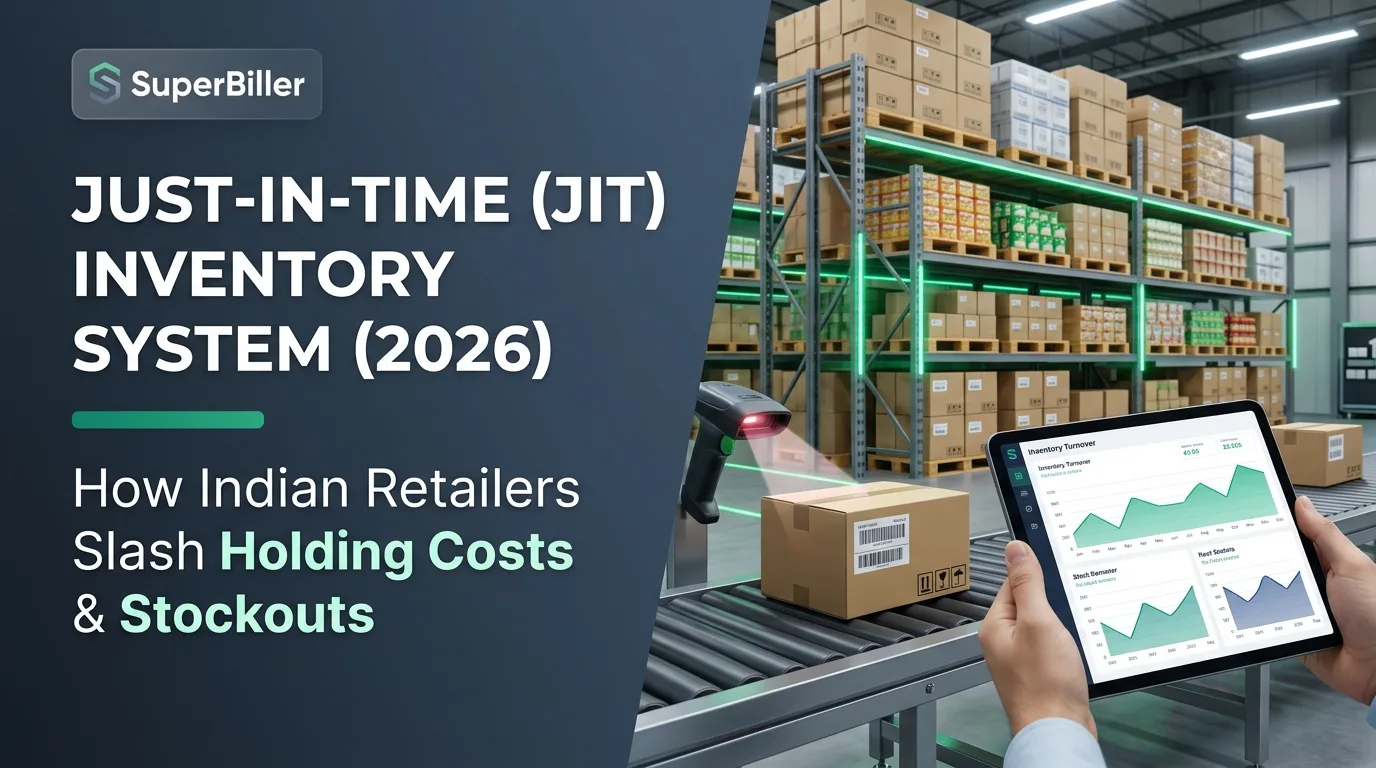
Master Just-In-Time (JIT) inventory: cut godown holding costs, eliminate expired stock, calculate turnover ratio (ITR), and implement hybrid JIT in retail.
In traditional Indian retail and wholesale trade, success was historically measured by the physical volume of stock piled up in a godown. Kirana merchants, garment wholesalers in Chandni Chowk, and electronics dealers in Lamington Road believed that "more stock means more safety." However, in today's fiercely competitive market with soaring commercial rents, thin profit margins, rapid product obsolescence, and expensive working capital loans (often bearing 12% to 16% annual interest), overstocking is the fastest route to insolvency. Every unsold carton sitting in a godown is locked cash that earns zero return.
To solve this liquidity trap, modern enterprises and agile Indian retailers are adopting the Just-in-Time (JIT) Inventory Management System. Originally developed by Japanese industrialists to rebuild postwar manufacturing, JIT has evolved into a powerhouse inventory strategy that aligns purchasing schedules directly with customer demand.
By ordering goods only as they are needed for sale or production, businesses slash warehouse holding costs, eliminate expired stock, and dramatically improve cash flow velocity.
This definitive 2026 operational handbook breaks down what is just in time inventory, how it contrasts with traditional "Just-in-Case" stocking, mathematical formulas for calculating inventory turnover and reorder points, real-world case studies for Indian storekeepers, and practical steps to implement a hybrid JIT model using cloud billing and POS technology.
What is a Just-In-Time (JIT) Inventory System? (BLUF Answer Box)
Bottom Line Up Front (BLUF):
A Just-in-Time (JIT) inventory system is a demand-driven (pull) inventory management methodology where goods, raw materials, and retail stock are received from suppliers only as they are needed for immediate sale or production, rather than stockpiled in advance. Governed by lean principles originally derived from the Toyota Production System, JIT minimizes inventory carrying costs, prevents dead stock, and maximizes working capital efficiency by maintaining near-zero warehouse holding buffers.
flowchart TD
    subgraph Traditional Push System (Just-in-Case)
        A["Forecast Demand"] --> B["Mass Production / Bulk Purchase"]
        B --> C["Huge Godown Storage (High Holding Cost)"]
        C --> D["Push Goods to Customers"]
        D --> E["Unsold Stock / Expired Goods / Cash Trapped"]
    end
    subgraph Modern Lean Pull System (Just-in-Time)
        F["Customer Places Order / POS Sale"] --> G["Instant Signal to POS & Inventory"]
        G --> H["Automated Purchase Order to Vendor"]
        H --> I["Supplier Delivers Exact Quantity Just in Time"]
        I --> J["Immediate Dispatch / Counter Sale (Zero Dead Stock)"]
    end
The Origins & Core Philosophy of JIT: From Toyota to Indian Retail
The roots of the JIT philosophy date back to the 1950s at the Toyota Motor Corporation in Japan, spearheaded by industrial engineer Taiichi Ohno. Operating in a resource-scarce postwar economy, Toyota could not afford the massive capital expenditure required to maintain colossal warehouses like American automakers. Ohno developed the Toyota Production System (TPS), built around the elimination of Muda (Waste).
In TPS philosophy, inventory itself is viewed as a form of waste because stored stock consumes space, requires insurance, risks damage, and ties up liquid capital. To eliminate this waste, Ohno introduced the Kanban system—a visual signaling card that triggered procurement only when an upstream station consumed an item.
The Modern Indian Retail Transformation:
In India, progressive supermarket chains (like DMart), modern electronics stores (Croma, Reliance Digital), and fast-growing D2C consumer brands have adapted JIT principles to retail distribution:
- Rather than keeping 60 days of slow-moving inventory in a high-rent city store, they maintain a tight 3 to 7 days of stock.
- Local regional distribution centers (RDCs) and automated vendor replenishments restock store shelves daily based on real-time Point of Sale (POS) scan data.
- Kirana store owners utilize WhatsApp and B2B distributor apps (like Udaan, Metro Wholesale, and local FMCG super-stockists) to place night orders for morning delivery, effectively running a localized JIT model.
To organize product catalogs with automated SKU prefixes before launching JIT reordering, generate clean item codes with SuperBiller's Free SKU Generator.
Traditional Just-in-Case (JIC) vs Just-in-Time (JIT): Head-to-Head Comparison
Understanding the structural differences between traditional stocking and lean inventory management reveals why top retailers are abandoning bulk warehousing:
| Operational Parameter | Traditional "Just-in-Case" (JIC) | Lean "Just-in-Time" (JIT) |
|---|---|---|
| Inventory Strategy | Push Strategy: Buy in massive bulk based on optimistic long-term forecasts. | Pull Strategy: Procure inventory only when triggered by actual consumer demand. |
| Warehouse Space Needed | Large godowns, multi-tier pallet racks, and secondary storage facilities. | Minimal backroom storage; goods move directly from delivery dock to sales floor. |
| Working Capital Trapped | High: 40% to 60% of total business capital locked in stagnant warehouse stock. | Low: Capital remains liquid in bank accounts or invested in revenue growth. |
| Holding & Carrying Costs | Extreme (20%–30% per year): High rent, security, lighting, insurance, and interest. | Minimal (3%–7% per year): Very low storage overhead and negligible insurance costs. |
| Risk of Obsolescence & Expiry | Severe: High rates of expired food/medicines, damaged packaging, and unsellable outdated styles. | Near Zero: Stock turns over rapidly within days, ensuring 100% fresh inventory. |
| Dependence on Suppliers | Low day-to-day dependence; existing stock cushions vendor delays. | Critically High: Requires 100% reliable, vetted suppliers with punctual delivery logistics. |
| Response to Demand Surges | Handled easily through existing safety stock piles. | Requires rapid supplier ramp-up; risks temporary stockouts during sudden spikes. |
| Order Frequency & Size | Infrequent, massive bulk orders (quarterly or bi-monthly). | Frequent, small-batch orders (daily, bi-weekly, or weekly replenishment). |
To track multi-godown stock transfers and monitor real-time stock levels across branches, explore SuperBiller's Cloud Inventory Software.
Essential Inventory Formulas for JIT Execution
Executing JIT successfully requires mathematical precision. Guessing order quantities leads either to crippling stockouts or accidental overstocking. Master these three foundational inventory formulas:
1. Inventory Turnover Ratio (ITR)
The Inventory Turnover Ratio measures how many times your entire store inventory is sold and replaced over a given period (typically one year). A higher ratio indicates superior capital efficiency.
$$ ext{Inventory Turnover Ratio (ITR)} = rac{ ext{Cost of Goods Sold (COGS)}}{ ext{Average Inventory at Cost}}$$
$$ ext{Average Inventory} = rac{ ext{Beginning Inventory} + ext{Ending Inventory}}{2}$$
- Practical Example:
A consumer electronics retailer has an annual COGS of ₹1,20,00,000.- Under traditional JIC, average inventory held is ₹40,00,000 $ ightarrow ext{ITR} = 3.0$ (Stock turns once every 122 days).
- Under lean JIT, average inventory held is ₹10,00,000 $
ightarrow ext{ITR} = 12.0$ (Stock turns once every 30 days!).
The JIT model frees up ₹30 Lakhs of hard liquid cash while generating the exact same sales volume.
2. Days Sales of Inventory (DSI)
Measures the average number of days it takes for your inventory to turn into cash:
$$ ext{DSI} = left( rac{ ext{Average Inventory}}{ ext{COGS}} ight) imes 365 = rac{365}{ ext{ITR}}$$
For high-performing JIT retail stores, target a DSI of 7 to 15 days for fast-moving items, compared to 60–90 days in traditional shops.
3. Reorder Point (ROP) with JIT Safety Buffer
In pure theory, JIT maintains zero safety stock. In the reality of Indian road logistics, maintaining a small buffer for transit delays is essential:
$$ ext{Reorder Point (ROP)} = ( ext{Average Daily Unit Sales} imes ext{Lead Time in Days}) + ext{Safety Stock Buffer}$$
- Example:
A supermarket sells 50 bags of 5kg Basmati Rice per day. The distributor takes 2 days to deliver. The manager maintains a safety buffer of 25 bags.
$$ ext{ROP} = (50 imes 2) + 25 = 125 ext{ bags}$$
The moment stock hits 125 bags, the POS system triggers an automated Purchase Order!
To calculate exact trade margins and selling price markups before finalizing vendor purchase contracts, use SuperBiller's Profit Margin Calculator.
Major Advantages of the JIT System for Indian Businesses
Adopting a lean JIT model delivers transformative balance-sheet advantages for Indian retailers and MSMEs:
graph LR
    subgraph JIT Core Benefits
        A["Slash Godown Rental Overhead"]
        B["Massive Working Capital Liquidity"]
        C["Elimination of Expired / Damaged Stock"]
        D["Agile Adaptation to Market Trends"]
        E["Strengthened Vendor Relationships"]
    end
    JIT Core Benefits --> F["Higher Return on Capital Employed (ROCE)"]
- Dramatic Reduction in Holding & Storage Costs:
Commercial warehouse rentals in metropolitan hubs (Mumbai, Bengaluru, Delhi-NCR) range from ₹35 to ₹80 per square foot. By keeping minimal backroom inventory, a retailer can shrink warehouse footprint by 60% to 70% or convert expensive storage space into prime customer retail displays. - Freed Working Capital & Reduced Loan Interest:
Most Indian traders fund inventory through bank Cash Credit (CC) limits or overdrafts carrying 11% to 15% interest. Reducing inventory by ₹25 Lakhs saves ₹2,75,000 to ₹3,75,000 in pure bank interest expense every year, flowing straight to net profit. - Elimination of Dead Stock and Product Expiry:
In FMCG, packaged foods, cosmetics, and pharmaceuticals, expired goods represent pure dead loss. JIT ensures that products arrive fresh from the factory with maximum shelf life remaining, delighting consumers and preventing discard write-offs. - Agility to Capitalize on Fast-Moving Trends:
When fashion styles or smartphone models change, merchants burdened with heavy stock are forced to liquidate at deep losses. JIT retailers keep their catalogs nimble, enabling them to introduce trending products within 48 hours. - Enhanced Supplier Pricing Power:
Ordering small batches frequently establishes regular, predictable cash flow for your suppliers. Transporters and distributors prioritize reliable, daily-ordering accounts with preferential delivery windows and volume rebates.
To generate formal purchase orders with automated vendor GSTIN lookup, create purchase vouchers instantly using SuperBiller's Free Purchase Order Generator.
Critical Disadvantages & Vulnerabilities in the Indian Context
While JIT is exceptionally profitable in theory, blindly copying Toyota's zero-stock model in India without understanding local infrastructural realities can lead to business catastrophe:
flowchart TD
    A["Vulnerabilities of Pure JIT in India"]
    A --> B["Transport Strikes & Highway Checkpost Delays"]
    A --> C["Vendor Non-Compliance & Production Bottlenecks"]
    A --> D["Unpredictable Festival & Wedding Demand Spikes"]
    A --> E["Bulk Quantity Discount Loss (Loss of Scale Economies)"]
    B & C & D --> F["Out of Stock Counter -> Lost Customers to Competitors"]
1. Fragile Supply Chain & Transit Disruptions
Indian logistics is subject to highway jams, monsoon flooding, vehicle breakdowns, and regional transport strikes. If your store relies on a delivery truck arriving at 8:00 AM every morning and that truck is detained at a state checkpost due to an expired E-Way bill, your shelves sit empty, and walk-in shoppers walk over to your competitor.
2. Extreme Vulnerability to Vendor Failure
Under JIT, you are only as reliable as your weakest supplier. If a key manufacturer experiences machinery failure, labor strikes, or raw material shortages, your entire business comes to a grinding halt because you have zero inventory cushion.
3. Festival Demand Surges (The "Diwali & Wedding" Factor)
In India, consumer demand does not flow in a smooth, predictable line. During Diwali, Dhanteras, Eid, Durga Puja, and the winter wedding season, retail sales can surge by 300% to 500% in a 10-day window. A rigid JIT model will collapse during festive rushes because distributors themselves run out of stock.
4. Loss of Bulk Purchasing Discounts
Suppliers offer substantial tiered price discounts for truckload orders (e.g., 5% extra discount for buying 500 cartons at once). Placing daily micro-orders of 10 cartons means forfeiting bulk trade schemes and paying higher per-unit freight costs.
How Indian MSMEs Implement a Practical "Hybrid JIT" Model
The solution for Indian store owners is NOT a dogmatic "zero inventory" approach, but a Pragmatic Hybrid JIT Model tailored to local trading conditions:
flowchart TD
    A["Categorize Store Inventory via ABC Analysis"] --> B{"Item Classification"}
    B -- "Category A (High Value / Fast Moving)" --> C["Pure JIT Protocol: Daily Reorder, 3-Day Buffer"]
    B -- "Category B (Moderate Value / Steady Sales)" --> D["Hybrid JIT: Weekly Replenishment, 10-Day Buffer"]
    B -- "Category C (Bulk Commodity / Seasonal Items)" --> E["Traditional JIC: Bulk Purchases for Best Trade Discounts"]
    C & D & E --> F["Unified Cloud POS Auto-Reordering System"]
Step-by-Step Implementation Blueprint:
- Classify Stock via ABC Analysis:
- Category A Items (Top 10% items generating 70% revenue): High-cost electronics, premium cosmetics, branded oils. Apply strict JIT with frequent 2-day replenishments.
- Category B Items (Steady movers): Standard grocery, hardware spares, toiletries. Keep 7 to 10 days of safety stock.
- Category C Items (Low-value bulk commodities): Sugar, loose pulses, packing materials. Buy in bulk to capture maximum truckload freight discounts.
- Select & Vet Multi-Vendor Backup Channels: Never depend on a single supplier for critical products. Maintain primary and secondary distributors for every high-velocity category.
- Deploy Real-Time Barcode POS Scanning: Manual stock registers cannot support JIT. Every sale at the checkout counter must instantly deduct units from the digital ledger using a barcode reader connected to your POS software.
- Establish Automated Reorder Level (ROL) Alerts: Configure your billing software to trigger instant notifications when stock dips below the safety buffer, automatically drafting a purchase order for vendor dispatch.
- Pre-Festive Buffer Ramping: Four weeks prior to major festive seasons, temporarily pause JIT protocols for gift packs, dry fruits, and festive inventory, stocking up to capture peak seasonal revenue.
To manage high-speed checkout counters with instant barcode scanning and thermal receipt printing, run your store with SuperBiller's Retail POS System.
Related In-Depth Guides & Recommended Reading
- Timesheet & Employee Tracking Guide: What is a Timesheet? Complete Guide, Excel Templates & Salary Computation (2026) — Managing warehouse labor shifts and overtime.
- E-Way Bill Transit Compliance: E-Way Bill Login & Portal Generation Guide (2026) — Ensuring JIT freight trucks travel without highway detention.
- Expired E-Way Bill & Vehicle Breakdowns: Expired E-Way Bill Extension Rules & 200% Penalty Defense — Handling transit emergencies when running lean inventory.
- GTA Transport Services & Freight Rates: GST on GTA Transport Services (2026): 5% RCM vs 12% Forward Charge — Managing logistics freight contracts for frequent deliveries.
- Bilty / Lorry Receipt Templates: Bilty Format in Excel & Word (2026): Free Lorry Receipt (LR) Download — Documenting commercial dispatch vouchers.
Frequently Asked Questions (FAQs)
Q1. What is the fundamental difference between JIT and JIC inventory management?
The primary difference lies in the replenishment trigger. Just-in-Time (JIT) is a "pull" system where inventory is procured only after customer demand occurs, keeping warehouse holding near zero. Just-in-Case (JIC) is a traditional "push" system where businesses manufacture or buy massive stock in advance based on sales forecasts to prevent unexpected stockouts.
Q2. Is the JIT inventory system suitable for small retail Kirana shops in India?
Yes, in a hybrid form. Small Kirana stores have limited shelf space and restricted working capital. By using modern distributor delivery networks to order fast-moving goods (dairy, branded snacks, bread, staples) on a daily or alternate-day basis, Kirana merchants operate a highly effective localized JIT model that prevents expired stock and frees cash.
Q3. How does JIT inventory improve a company's cash flow?
Under traditional stocking, hundreds of thousands of rupees are trapped on warehouse shelves as unpaid assets. JIT shrinks the time lag between purchasing an item and selling it to a consumer. Because inventory turns into cash within days rather than months, working capital cycles accelerate, bank overdraft interest drops, and liquidity increases dramatically.
Q4. What is a Kanban system in JIT manufacturing?
A Kanban is a visual signaling device (originally physical colored cards, now digital triggers in ERP software) used in JIT systems. When stock at a sales counter or assembly line drops below a specified threshold, a Kanban signal is automatically transmitted to the stockroom or supplier to replenish that exact quantity, preventing overproduction.
Q5. What happens when a JIT supplier fails to deliver on time?
When a supplier misses a delivery deadline in a pure JIT environment, the business suffers an immediate stockout because there is no warehouse buffer. Sales halt, and customers migrate to competitors. To safeguard against this risk, Indian merchants implement a "Hybrid JIT" model maintaining a small 2 to 3-day safety stock buffer and pre-qualifying secondary backup suppliers.
Q6. Which industries benefit the most from Just-In-Time inventory?
JIT is most beneficial in industries characterized by high holding costs, perishable goods, or rapid product obsolescence. Key sectors include automobile manufacturing, fast-moving consumer goods (FMCG), consumer electronics, pharmaceuticals, fashion apparel, and commercial restaurant kitchens.
Industry References & Authoritative Sources
For deeper study of lean manufacturing, inventory engineering, and supply chain management:
- Ministry of Micro, Small and Medium Enterprises (MSME): Lean Manufacturing Competitiveness Scheme guidelines (msme.gov.in).
- Indian Institute of Materials Management (IIMM): Principles of inventory turnover and supply chain optimization (iimm.org).
- Toyota Motor Corporation: The Official Toyota Production System (TPS) & Lean Philosophy Archives.
- National Productivity Council (NPC) India: Lean manufacturing toolkits and productivity benchmarks (npcindia.gov.in).
This guide is authored by the SuperBiller Tax & Retail Operations Desk and fact-checked against official Central Board of Indirect Taxes and Customs (CBIC) circulars, the CGST Act 2017 (Rule 46 & Section 31), and latest GST Council threshold updates. SuperBiller provides MSMEs with compliant billing technology, 80mm thermal printing, and automated tax workflows.
Ready to automate your GST Billing & 80mm POS?
Generate your first tax invoice in under 30 seconds. 100% offline-ready.


